

SOLAR system
Everything to know about how our solar system works!
Solar System
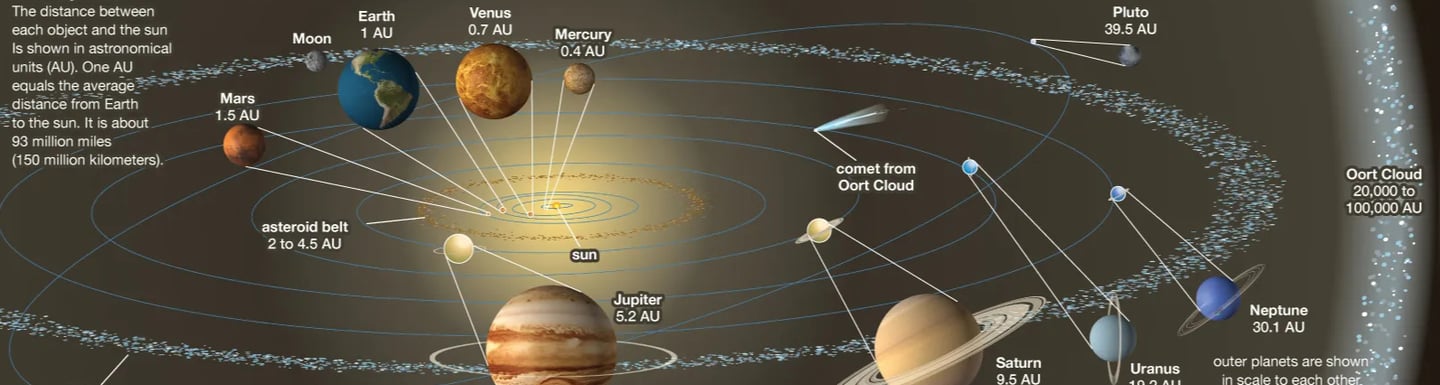
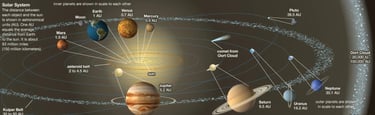
Here you can see a glimpse of our Solar System, the distance between each object and the sun is shown in astronomical units (AU), one AU equals the average distance from earth to the sun, which is approximately 93 million miles or 150 million kilometers.

Solar Planets
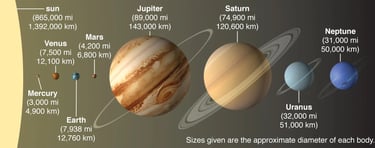
Here you can see a glimpse of our Solar Planets and the approximate diameter of each planet, Sun (865,000 miles or 1,392,000 km), Mercury (3,000 miles or 4,900 km), Venus (7.500 miles or 12,100 km), Earth (7,938 miles or 12,760 km), Mars (4,200 miles or 6,800 km), Jupiter (89,000 miles or 143,000 km), Saturn (74,900 miles or 120,600 km), Uranus (32,000 miles or 51,000 km), Neptune (31,000 miles or 50,000 km).
Solar & Seasonal Tracker
This is an advanced solar and seasonal calculator that monitors localized sun altitude metrics, daily sunrise or sunset timelines, and astronomical season countdown parameters dynamically within an intuitive dashboard layout, tracking real-time orbital arcs safely through native browser scripts, this responsive widget updates horizon data values smoothly to maintain the design properties of your utility site section.
Operating on pure trigonometric solar position equations, this monitoring engine translates complex azimuth algorithms and declination variables into a seamless, high-velocity data stream. The core script dynamically tracks the changing solar zenith angles relative to your precise geographical coordinates, providing pinpoint event timing updates that adapt instantly to local elevation scales. By calculating these astronomical variables natively on the user's device, the module removes server load latency to deliver fluid, instantaneous transition data that perfectly integrates with your lunar cycle trackers, multi-planetary engines, and natal chart studios.
Lunar & Geometry Tracker
This is an advanced lunar geometry calculator that tracks real-time moon phase percentages, classification names, and dynamic moonrise or moonset times based on user coordinates, running calculations natively through the synodic orbit algorithm, this responsive companion widget renders a beautiful progress ring to complement the visual style of your existing solar tracking dashboard block.
Built to handle complex tidal mechanics and orbital drift variables, this tracking framework automatically updates its lunar illumination matrix using your browser's precise timezone and latitudinal parameters. The engine isolates the synodic month—the exact 29.53-day cycle from one new moon to the next—to eliminate positional errors and output accurate apogee and perigee alerts instantly. By blending high-fidelity vector progress rings with deep mathematical data feeds, this utility acts as a vital orbital companion, linking the gravitational pull of local tides with your larger heliocentric engines, stellar sky maps, and birth chart configurations for complete night-sky mastery.
Live Celestial Star Map
Monitor galactic coordinates instantly with a high-visibility Celestial Star Map Engine tracking magnified star bodies and maximized constellation label layers.
Designed for seamless night-sky navigation, this mapping framework uses real-time vector coordinates to trace cross-cultural constellation bounds and galactic longitude lines instantly. The interface completely eliminates visual noise by prioritizing high-contrast stellar bodies alongside the magnified text layers, making it effortlessly legible on mobile devices or tablets out in the field. By serving as an deep-space compass, this tracking grid bridges the gap between deep-sky observation and local planetary cycles, providing a comprehensive cosmic backdrop that anchors your heliocentric engines and birth chart studios into a single, unified stargazing suite.
Live Real Time Planetarium
Chart multi-planetary heliocentric orbits instantly with an enhanced high-visibility Planetarium Engine featuring magnified planetary spheres and maximized text labeling layers.
Engineered for both deep space educators and cosmic hobbyists, this interface bypasses cluttered layouts to deliver a clean, expansive window into our solar system. The engine applies advanced vector tracking to trace true orbital periods and real-time celestial coordinates, while the scaled labeling layers ensure text remains perfectly legible even during fast simulation overrides. By isolating the sun as the central mathematical anchor of the coordinate grid, this system offers a crystal-clear, distortion-free perspective of interplanetary space that beautifully complements your birth chart studio and solar cycle path visualizers.
OmniAstro Birth Chart Studio
Calculate your personalized natal placements instantly with this free, real-time birth chart studio, featuring precise calculations for your sun, moon, rising sign, and full 14-point planetary ephemeris across major global cities.
Behind this real-time studio runs a high-precision celestial engine that cross-references your exact time and geographical birth coordinates with the official Swiss Ephemeris data models. By calculating the precise geometric alignments of the solar system at your exact moment of birth, the system maps out the mathematical angles, houses, and planetary aspects that form your unique cosmic blueprint. This advanced computing method eliminates manual calculation errors, delivering an incredibly accurate and detailed snapshot of the sky that serves as the perfect foundational anchor alongside your solar path and calendar tracking widgets.
Solar Seasons
Our interactive Solar Cycle Tracker maps out the four major astronomical milestones of Earth's orbit in real-time. By clicking the buttons or dragging the sun node along the celestial trajectory path, you can explore the seasonal shifts that govern our planetary cycle. This responsive visualizer traces everything from the peak daylight duration of the Summer Solstice and the prolonged nights of the Winter Solstice, to the perfectly balanced day and night intervals of the Vernal and Autumnal Equinoxes. Use the built-in calendar countdown engine below the graph to see exactly how many days remain until the next global seasonal transition.
The changing of our seasons is dictated by the Earth's axial tilt of 23.5 degrees relative to its orbital plane around the Sun. As our planet journey's along its annual path, this constant inclination causes varying intensities and durations of solar radiation to reach different latitudes. During the solstices, one hemisphere reaches its maximum inclination toward or away from the Sun, creating extreme differences in daylight hours. Conversely, the equinoxes mark the precise moments when the Earth's axis is tilted neither toward nor away from our star, resulting in the celestial equator receiving direct, perpendicular sunlight. This elegant geometry ensures an ever-shifting, predictable natural rhythm that sustains global climates and ecosystems year after year.
Disclaimer: Please note that all tools and info on this website are purely for entertainment purposes. We do not take any responsibility for the validity or accuracy of anything you see on this website.
SstatsS.com © copyright 2026